
Minority Report
August 4, 2011 In a previous article (Is Religion becoming Extinct? April 1, 2011), I reviewed the scientific principle behind one method for the growth of a population type at the expense of others. In the case of Ostwald ripening, when larger entities compete against smaller ones for a fixed resource, the larger entities grow and the smaller ones become extinct. The statistics of Ostwald ripening were developed to describe the growth of solids in solution, but the same principles of statistical mechanics will describe other systems as well. One example of this is large corporations buying smaller ones to make even larger corporations. Others are the decline of religious affiliation in many societies,[1-2] and the decline of languages.[3] The acceptance of an idea could be analyzed as a similar competition, a competition between believers and nonbelievers, but there are some difficulties in this approach. Ideas are not contained in a resource reservoir that's accessible to all individuals at all times. Ideas need to propagate between individuals, so a network approach makes more sense. The more people there are in a network who subscribe to an idea, the faster the idea will propagate, simply because there are more connections. As you can imagine, the propagation rate will be nonlinear. A team of scientists at the Social Cognitive Networks Academic Research Center at Rensselaer Polytechnic Institute have published a study in the recent issue of Physical Review E that examines the reversal of a prevailing majority opinion in a population by randomly distributed zealots.[4-6] These zealots were designed to be immune to influence; that is, they would never change their opinion. They were also designed to be vocal proponents of their minority opinion. The research team calls its system the binary agreement model. According to the model, the following process occurs at each simulation time step, modified to reflect the fact that the minority individuals will not change their opinion:• A speaker is chosen at random.The initial state of the system is that the p fraction of minority individuals have just one item on their opinion list, and they will not change their opinion. What the research team found was that there exists a tipping point pc of about 10% of the population at which there is a dramatic decrease in the time Tc at which an entire population will subscribe to the minority view. They find, specifically, that
• The speaker voices a random opinion from his opinion list to a randomly chosen neighbor.
• If the neighbor has that opinion in his list, both the speaker and listener retain only that opinion.
• Otherwise, the listener adds the spoken opinion to his list.
Tc ~ exp[α(p)N], for p<pcwhere N is the number of people (nodes in the network), and α(p) is a function that depends on the fraction subscribing to the initial minority view. As can be seen in the following figure, the tipping point behavior is confirmed for a wide range of random graphs, including Erdös-Rényi graphs
Tc ~ ln(N), for p>pc
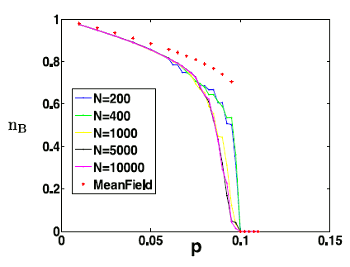 | Density of nodes in state 'B' as a function of committed fraction p for Erdös-Rényi graphs and scale-free networks that show behavior similar to opinion model. (Via arXiv Preprint Server). |
"When the number of committed opinion holders is below 10 percent, there is no visible progress in the spread of ideas. It would literally take the amount of time comparable to the age of the universe for this size group to reach the majority... Once that number grows above 10 percent, the idea spreads like flame."[6]It's always good to verify the predictions of your theory with an experiment. As I described in a previous article (Hedonometrics, January 31, 2011), social networks are being data mined by computer scientists, and they've derived some very interesting results. Experimental verification of a model of this sort might be possible for a passive observer looking for the shift in occurrence of keywords on Twitter postings, but historical data are acceptable. The authors of the Physical Review paper cite US women's voting rights in the early twentieth century and racial equality in the US in the mid-twentieth century as examples. The latter occurred after the African-American population reached ten percent.
 | Did his dream involve Erdös-Rényi graphs? Research on opinion tipping points in social networks indicates that racial equality in the US may have been inevitable after the African-American population reached ten percent. Martin Luther King, Jr., in 1964, with a medallion received from New York City Mayor, Robert F. Wagner. (Photograph via Wikimedia Commons). |

References:
- Daniel M. Abrams, Haley A. Yaple and Richard J. Wiener, "A mathematical model of social group competition with application to the growth of religious non-affiliation," arXiv Preprint Server, January 14, 2011.
- Jason Palmer, "Religion may become extinct in nine nations, study says," BBC News, March 22, 2011.
- Daniel M. Abrams and Steven H. Strogatz, "Linguistics: Modelling the dynamics of language death," Nature, vol. 424, no. 6951 (August 21, 2003), pp. 900 ff.. PDF file here.
- J. Xie, S. Sreenivasan, G. Korniss, W. Zhang, C. Lim and B. K. Szymanski, "Social consensus through the influence of committed minorities," Physical Review E, vol. 84, no, 1 (July 22, 2011), Document No. 011130 (8 pages).
- J. Xie, S. Sreenivasan, G. Korniss, W. Zhang, C. Lim and B. K. Szymanski, "Social consensus through the influence of committed minorities," arXiv Preprint Server, April 25, 2011.
- Gabrielle DeMarco, "Minority Rules: Scientists Discover Tipping Point for the Spread of Ideas," RPI Press Release, July 25, 2011
- Jason Palmer, "Religion may become extinct in nine nations, study says," BBC News, March 22, 2011.